Are you choosing the behaviour or is the behaviour choosing you?
Understanding obsessive and addictive patterns
Most of us have a behaviour we lean on. Be that checking the phone, a late-night scroll, eating copious amounts of treats, a punt on the football, a hard gym session after a rough day. For the most part these are harmless, and some can even be good for us. The question worth asking is not whether you do them, but whether you are still the one deciding.
The line between a strong habit and something more compulsive is not always obvious, and it tends to move slowly. Understanding how ordinary behaviours can take on a life of their own, and when that is worth paying attention to, is a useful starting point.
Not all repetition is a problem
To be clear and up front, you don’t need to treat every routine or passion as suspect. Plenty of repeated behaviours are constructive - a consistent exercise routine, absorbing work, a hobby you lose hours in, or a daily practice that steadies you. These can build health, identity and meaning.
As a Psychologist, we can draw a distinction between healthy engagement and a behavioural or “process” addiction.
What is a process addiction
A process addiction is often described as compulsively engaging in a behaviour that stimulates the brain’s reward system despite mounting negative consequences. For most, a simple to understand example of this is alcohol or drugs, the feeling is great at the time but those negative impacts compound. The behaviours involved, gambling, gaming, shopping, screen use, sex, even exercise, are usually a normal part of life. What changes is the relationship to them.
A useful rule of thumb from the clinical literature: passionate involvement is organised around what you gain, while a developing addiction is increasingly organised around avoiding what you feel when you stop.
How something helpful can tip over
The same behaviour can sit on either side of that line depending on the person and the pattern. Exercise is the clearest example. For most people it lifts mood, sleep and health. For a smaller group it becomes compulsive: the amount needed keeps climbing to get the same effect, missing a session brings anxiety, irritability or restlessness, and training continues despite injury or at the cost of relationships and other commitments. The activity is identical however the difference is control and consequence.
Underneath, the mechanism is consistent across behaviours. When a behaviour reliably produces relief or reward, the brain’s reward circuitry reinforces it. Over time the behaviour can shift from something you choose because it feels good to something you repeat to avoid feeling bad. Process addictions often sit on top of underlying difficulties such as anxiety, depression or unresolved stress, offering short-term relief that quietly deepens the longer-term problem.
What the evidence recognises, and what it doesn’t (yet)
This is an area where caution matters, because the science is still settling. Only two behavioural addictions are formally recognised as clinical disorders. Gambling disorder is the single behavioural addiction included in the psychiatric diagnostic manual DSM-5, and gaming disorder was recognised by the World Health Organization in the ICD-11 in 2018 as a “disorder due to addictive behaviours”.
For gaming disorders, the WHO is deliberately careful about the threshold: the pattern must show impaired control, gaming taking priority over other interests and daily life, and continuation despite negative consequences, and it would normally need to be evident for around 12 months and cause significant impairment before a diagnosis applies. In other words, enjoying games a lot is not a disorder.
Other patterns, compulsive sexual behaviour, compulsive buying or shopping, and problematic social media use, are considered clinically relevant and are actively researched, but they are not yet established as formal diagnoses. That uncertainty is a reason why Healthcase Psychologists specialises in helping in these areas - these are distressing and cannot be dismissed. Rather, it’s critical to focus on these as functions and impacts rather than worry about labels.
Why Australia is a high-risk environment for some of these
Context shapes risk, and some behaviours are simply more available here, gambling being the standout. Australia has one of the highest rates of gambling participation in the world, and gambling is recognised as a significant public health issue, with a meaningful minority of adults experiencing significant problems and a larger group at moderate risk of harm.
Researchers point to accessibility as a key driver. The move to online and mobile betting has removed many of the natural limits that a physical venue once imposed, making sports betting in particular available around the clock. When a rewarding behaviour is always within reach, it has become harder to interrupt the loop. Further, Australia has had relatively permissive rules around gambling advertising, with landmark reforms due to commence on 1 January 2027. Though, some argue these new changes still aren’t strong enough.
Notably, research has found that internet use among young people in Australia is near-universal and electronic gaming very common, and while most use technology without problems, a small proportion report problematic patterns, often alongside higher psychological distress. The adolescent brain, still developing into the mid-twenties, tends to pair a highly responsive reward system with impulse control that is still maturing, which is part of why early patterns deserve attention rather than alarm.
Signs a behaviour may be taking over
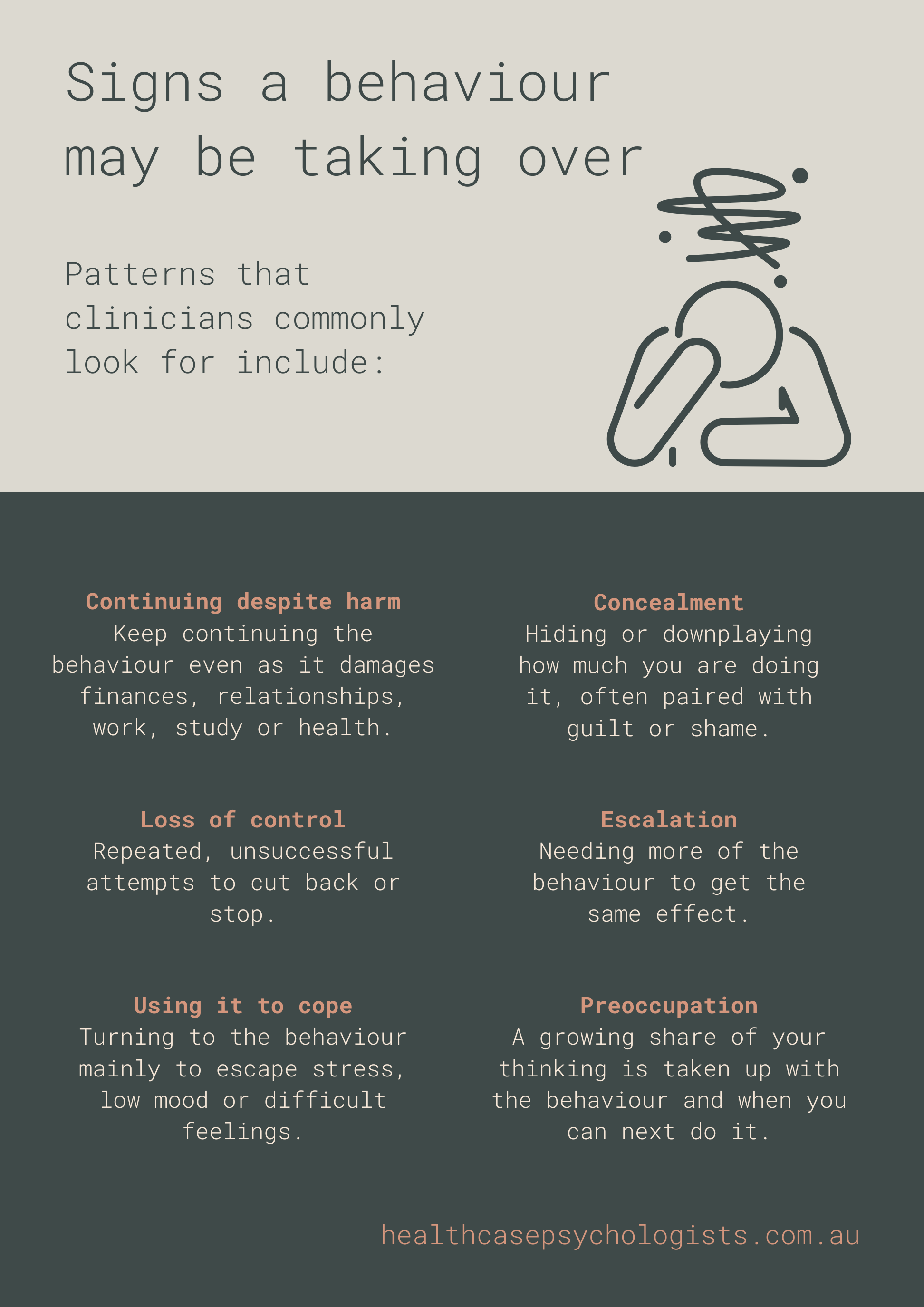
No single sign confirms a problem, and everyone overdoes things occasionally. It is the cluster and the trajectory that matter. Patterns that clinicians commonly look for include:
Preoccupation: a growing share of your thinking is taken up with the behaviour and when you can next do it.
Loss of control: repeated, unsuccessful attempts to cut back or stop.
Escalation: needing more of the behaviour to get the same effect.
Using it to cope: turning to the behaviour mainly to escape stress, low mood or difficult feelings.
Continuing despite harm: keep continuing the behaviour even as it damages finances, relationships, work, study or health.
Concealment: hiding or downplaying how much you are doing it, often paired with guilt or shame.
If several of these ring true and have persisted, it may be worth talking to someone in your life or a professional as the combination tends to be self-reinforcing and hard to shift by people on their own.
What tends to help
The encouraging finding across the research is that these patterns respond to support, and that recovery is realistic. A few consistent themes stand out.
Looking underneath the behaviour. Because process addictions frequently sit on top of anxiety, depression or stress, effective work usually addresses the underlying drivers rather than the surface behaviour alone. Treating only the symptom tends to be short-lived.
Changing the environment, not just the willpower. Where a behaviour is fuelled by constant availability, strategies that add friction and reduce access are often more effective than resolve on its own. This is especially relevant for online gambling and screen-based patterns.
Building other ways to cope. Much of the pull comes from the behaviour being the main tool for managing difficult feelings. Developing alternative, workable coping strategies is a central part of loosening its ‘grip’.
Acting earlier rather than at crisis point. As with most mental health concerns, patterns are generally easier to shift before they have fully entrenched. You do not need to have hit a low point to be worth helping.
Keeping the constructive version. The aim is rarely to eliminate a behaviour entirely, particularly for things like exercise or technology that have real benefits. More often it is to restore a relationship where you are choosing the behaviour, rather than the behaviour choosing you.
Not sure whether it’s a habit or something more?
If you have found yourself wondering whether a behaviour has started running you, that question alone is worth taking seriously, and it does not mean anything is wrong with you. Working out the difference between a strong habit and a pattern worth addressing is exactly the kind of thing a psychologist can help you think through. If it would help, I encourage you to reach out for an initial phone call to see if we’re the right fit.
Contact us
Phone(03) 9115 1485
Email info@healthcasepsychologists.com.au
This article provides general information and is not a substitute for individual clinical advice. If you or someone you know is in crisis, contact Lifeline on 13 11 14 or, in an emergency, call 000. For free, confidential gambling support, Gambling Help Online is available on 1800 858 858.
Sources
Productivity Commission and Australian gambling prevalence data on participation and gambling-related harm
University of Melbourne (Pursuit), commentary on accessibility of online and sports betting and problem gambling risk
Australian Government (Department of Infrastructure, Transport, Regional Development, Communications, Sport and the Arts), Gambling Reforms 2026
World Health Organization, ICD-11 definition of gaming disorder (2018/2022)
American Journal of Psychiatry, review of behavioural addictions and their diagnostic status in DSM-5 and ICD-11
Child and Adolescent Survey of Mental Health and Wellbeing, Australian data on internet use, electronic gaming and problematic behaviour among young people